How to Choose the Right Oled Touch Panel for Your Project?
When selecting an Oled Touch Panel, it is essential to understand your project's specific needs. According to a market research report by Grand View Research, the global OLED touchscreen market is expected to reach $35 billion by 2025. This growth highlights the importance of choosing the right panel for optimal performance and efficiency.
Industry expert Dr. Emily Chang emphasizes, "A well-chosen Oled Touch Panel can significantly enhance user experience." However, knowing the right specifications can be challenging. Various factors influence the decision, such as resolution, size, and interface compatibility. Today's consumers demand high-quality visuals and responsive touch capabilities.
Many projects fail due to inadequate panel selection. An improperly chosen Oled Touch Panel can lead to technical issues, increased costs, and poor user satisfaction. It is crucial to research and evaluate your options. Distinguishing between different manufacturers and technologies can be overwhelming. Yet, making an informed choice is vital for project success.

Understanding OLED Technology and Its Advantages
Understanding OLED technology is essential when selecting the right touch panel for your project. OLED stands for Organic Light Emitting Diode. It uses organic compounds to emit light when an electric current passes through. This technology provides vibrant colors and deep blacks, greatly enhancing visual quality. OLED panels are also thinner and lighter than their LCD counterparts, making them perfect for sleek designs.
When considering OLED panels, focus on the advantages they offer. They have faster response times, which is crucial for applications requiring quick refresh rates. Their wide viewing angles ensure that images remain crisp when viewed from different perspectives. This is particularly important in interactive devices. Additionally, OLED technology is energy-efficient, consuming less power when displaying darker images.
Tips: Look for panels with high pixel density for sharper images. Check the manufacturing date, as newer panels tend to have better longevity. Be aware of potential burn-in issues; it’s a common drawback. Exploring the trade-offs will help refine your choice. Ultimately, knowing the strengths and weaknesses will guide you to find the perfect OLED touch panel suited for your needs.
How to Choose the Right Oled Touch Panel for Your Project? - Understanding OLED Technology and Its Advantages
| Feature |
Description |
Advantages |
Applications |
| Display Quality |
High contrast ratio, vibrant colors, and wide viewing angles. |
Enhanced visual experience, suitable for artistic display. |
Consumer electronics, gaming consoles, multimedia displays. |
| Touch Sensitivity |
Capacitive touch technology for responsive interaction. |
Intuitive user experience, allows for multi-touch functionality. |
Smartphones, tablets, interactive kiosks. |
| Energy Efficiency |
Uses less power compared to LCD panels. |
Longer battery life in portable devices. |
Wearables, portable devices, automotive displays. |
| Durability |
Flexible substrates may provide higher durability in various conditions. |
Resistant to shock and impact in some applications. |
Wearable technology, automotive interiors. |
| Response Time |
Fast response times suitable for video playback. |
Minimizes motion blur in dynamic content. |
Gaming, video conferencing, interactive media. |
Key Factors to Consider When Choosing an OLED Touch Panel
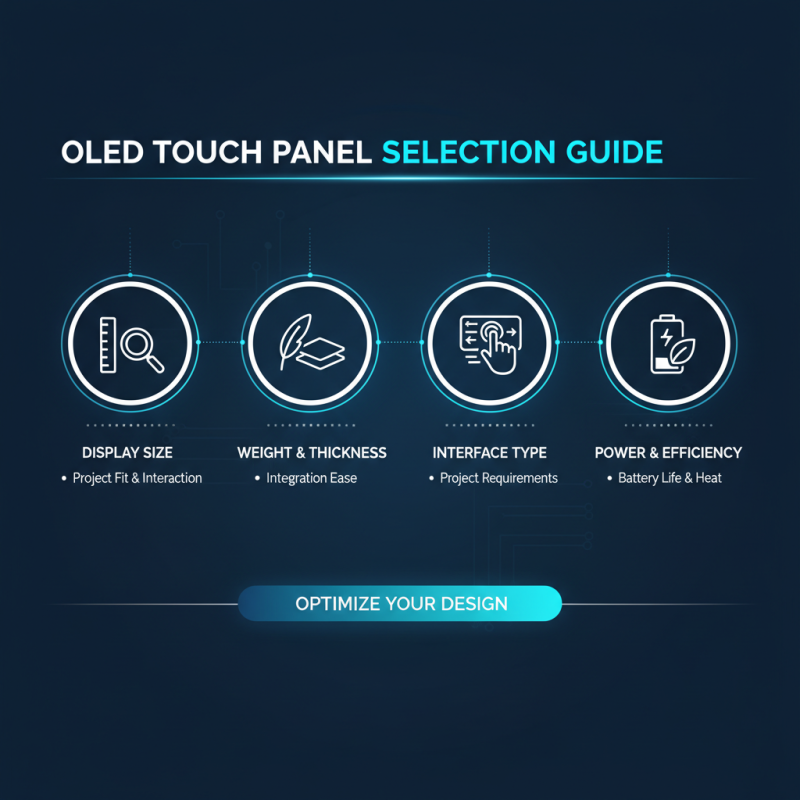
When selecting an OLED touch panel, several key factors come into play. The display size is crucial, as it needs to fit within your project’s design. A panel that is too large may overshadow other components. Conversely, a small panel may limit user interaction. Consider the weight and thickness as well. An overly bulky design can complicate integration.
Resolution is another essential detail. Higher resolution provides crisper images and clearer text. This is vital for applications requiring precise visual feedback. Response times matter too. A quicker response enhances user experience. However, these higher-quality panels may come with increased costs. It’s important to balance budget constraints with quality.
Lastly, consider the touch sensitivity features. Different projects may require various touch technologies. Evaluate how they will affect the user experience. Sometimes, it’s challenging to find the perfect fit. Trial and error may be necessary to discover what works best. Each project is unique, and no solution is flawless.
Assessing the Compatibility of OLED Panels with Your Project Requirements
When choosing an OLED touch panel, compatibility is crucial. Understand the specifications of your project before making a decision. Check the size, resolution, and interface requirements. Some panels may be too large or too small for your design. Additionally, different interfaces like I2C or SPI can impact integration.
Consider the operating environment as well. Will the panel be exposed to sunlight or extreme temperatures? These factors can affect display performance. Sometimes users overlook this detail, leading to inadequate visibility. Another important aspect is power consumption. A panel that draws too much power may not suit battery-operated devices.
Testing different panels can help identify which best fits your needs. Prototype your design with a few options. This process may reveal unexpected challenges. You might find that one panel looks great but is difficult to integrate. Identify these issues early to avoid complications later on. Compatibility is about more than just numbers; it's about real-world application and usability.
Evaluating Display Characteristics: Resolution, Brightness, and Color Accuracy
When selecting an OLED touch panel, evaluating key display characteristics is crucial. Resolution is one of the primary factors to consider. A higher resolution, such as 1920x1080 pixels, can provide sharper images. However, high resolution may increase processing demands, which affects overall system performance. Balancing resolution with the project's specific needs is essential.
Brightness is another critical characteristic. OLED displays usually provide better contrast than traditional LCDs. Yet, many OLED panels have varying brightness levels. For instance, some models achieve a peak brightness of 1000 nits. This can enhance visibility in bright environments. Yet, in low-light conditions, excessive brightness can cause eye strain. It's vital to choose a balance that matches typical usage conditions.
Color accuracy is where OLED panels shine. Their ability to reproduce vibrant colors is often superior to other technologies. Research shows that OLED panels can achieve over 100% of the sRGB color gamut. This makes them ideal for applications needing precise color differentiation. Yet, users should also consider color drift over time. Calibration might be necessary to maintain optimal performance. Selecting the right panel demands careful consideration of these factors, rather than a simple preference for specifications.
Budget Considerations and Sourcing Options for OLED Touch Panels
When selecting an OLED touch panel, budget considerations play a critical role. Prices can vary widely based on size, resolution, and features. It's essential to establish a clear budget early in the project. This helps avoid unexpected costs later. Explore various sourcing options to find competitive pricing. Some suppliers may offer bulk discounts, which can significantly reduce overall expenses.
Investigate the specifications that best suit your needs. For example, consider the display size and touch sensitivity. A high-resolution panel may look impressive, but it can also be expensive. Sometimes, a lower-resolution panel meets project needs perfectly. Prioritize what's essential for your application.
While browsing, newer options may tempt you, but they often come with a higher price tag. Reflect on the project’s timeline and flexibility with features. It’s okay to compromise on some aspects to stay within budget. Building prototypes helps assess whether chosen panels truly meet your expectations. This trial-and-error approach can save time and money in the long run. Remember, every decision shapes the project's outcome.