How to Choose the Best TFT LCD Display for Your Needs
Choosing the right TFT LCD display can significantly impact your project's success, whether you're designing a consumer product, developing an industrial application, or building an interactive kiosk. With a variety of options available on the market, selecting the best TFT LCD display tailored to your specific needs requires careful consideration of several key factors. These include factors such as screen size, resolution, brightness, and viewing angles, all of which can influence both functionality and user experience.
Understanding the unique features and specifications of TFT LCD displays is essential to making an informed decision. TFT (Thin Film Transistor) technology provides superior image quality and faster response times, making it a popular choice for applications that require high visual fidelity. In this article, we will guide you through the essential aspects to consider when choosing a TFT LCD display, helping you navigate through the available options to find the perfect match for your requirements. Whether you're prioritizing cost-effectiveness, performance, or specific functionalities, this guide will assist you in selecting a TFT LCD display that meets your expectations and enhances your project's overall effectiveness.
Understanding TFT LCD Technology: Fundamentals and Key Features
TFT (Thin Film Transistor) LCD technology has revolutionized the display industry by providing enhanced image quality and responsiveness. At its core, TFT LCD displays utilize a matrix of tiny transistors that control individual pixels, allowing for higher resolution and better color accuracy compared to traditional LCDs. This technology promotes faster refresh rates, which is particularly beneficial for applications that require quick image rendering such as gaming, video playback, and interactive user interfaces.
Key features of TFT LCD displays include wide viewing angles, minimal motion blur, and the ability to produce vibrant colors. The incorporation of technologies like IPS (In-Plane Switching) enhances these displays further by maintaining color consistency across different angles, making them ideal for collaborative environments where multiple viewers may be present. Additionally, the backlighting mechanisms used in TFT LCDs enable versatile brightness levels, ensuring visibility in various lighting conditions. Understanding these fundamentals can significantly influence the decision-making process when choosing a display that meets specific needs for clarity, speed, and overall performance.
Evaluating Resolution: The Impact of Pixel Density on Display Quality
When choosing a TFT LCD display, evaluating resolution is critical due to its direct impact on pixel density and overall display quality. Pixel density, measured in pixels per inch (PPI), determines how sharp an image appears on the screen. According to a study published by the Society for Information Display, a higher PPI not only enhances image sharpness but also allows for finer details to be rendered, particularly important for applications in graphic design, video editing, and gaming where clarity is paramount.
For instance, a display with a resolution of 1920x1080 (Full HD) on a 24-inch screen yields a pixel density of approximately 92 PPI, which offers decent clarity for general uses. However, stepping up to a 4K display with a resolution of 3840x2160 on a similarly sized screen results in a pixel density of around 183 PPI. This significant increase in pixel density ensures that individual pixels become less discernible, producing cleaner and more detailed images. Industry experts recommend that users consider their specific applications; for example, professional users should opt for displays with higher resolutions that support greater pixel densities to achieve optimal visual results.
When assessing the quality of a TFT LCD, it is also important to account for viewing distance, as it influences the perception of pixel density. A report from DisplayMate Technologies suggests that viewers are unlikely to discern individual pixels at a distance greater than 1.5 times the screen’s diagonal measurement for higher resolutions. Therefore, understanding both the display resolution and the intended viewing environment is essential for selecting the right LCD display, ensuring that users obtain the best visual experience tailored to their needs.
Evaluating Resolution: The Impact of Pixel Density on Display Quality
Assessing Size and Format: Choosing the Right Dimensions for Your Setup
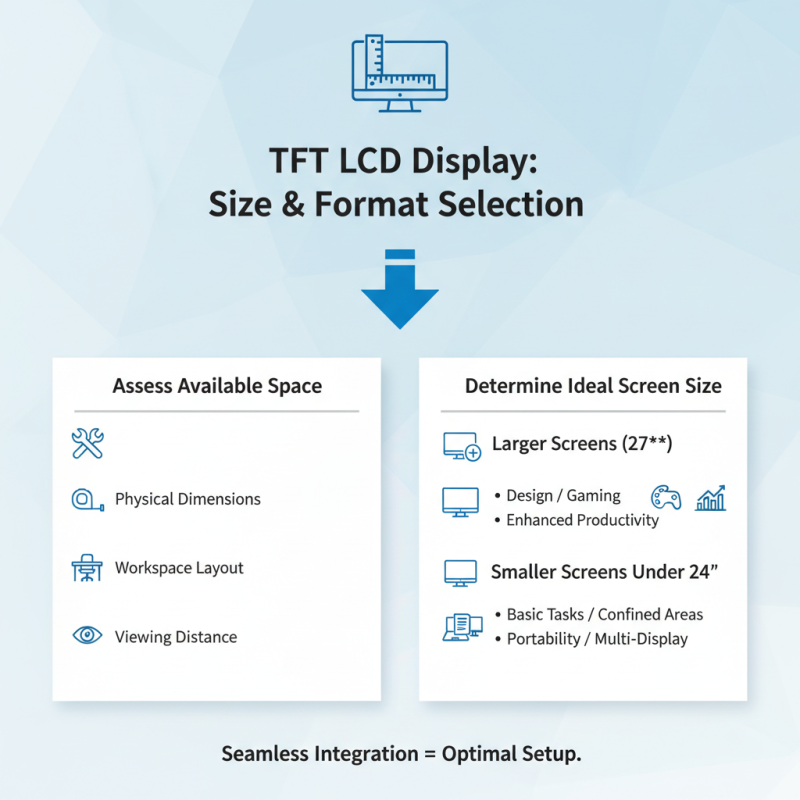
When selecting a TFT LCD display, assessing the size and format is crucial to ensuring the screen fits seamlessly into your setup. Start by evaluating the available space where the display will be installed. Consider both the physical dimensions of the display as well as the layout of your workspace. Factors like desk size, wall space, and viewing distance play a significant role in determining the ideal screen size. For instance, a larger screen may enhance productivity in design or gaming setups, while a smaller, more compact display may be more suitable for basic tasks or confined areas.
Additionally, the format of the display can affect how you interact with your content. Different aspect ratios, such as 16:9 or 4:3, can provide varying experiences depending on the type of media you frequently consume. Wider formats are often preferable for watching videos or multi-window productivity tasks, whereas traditional aspect ratios may be better for certain applications that require specific dimensions. Ultimately, choosing the right size and format will ensure that you not only achieve optimal performance but also enhance your overall user experience with the TFT LCD display.
Considering Backlight Types: LED vs. CCFL and Their Applications
When selecting a TFT LCD display, one of the critical factors to consider is the type of backlight technology used, primarily LED and CCFL. LED (Light Emitting Diode) backlighting has gained popularity due to its energy efficiency and capability to produce brighter displays with better color accuracy. LED backlights also enable thinner panel designs, making them ideal for modern applications where space is a premium. Furthermore, they have a longer lifespan and are less prone to issues such as flickering, making them a suitable choice for a wide range of uses, from mobile devices to large monitors.
On the other hand, CCFL (Cold Cathode Fluorescent Lamp) backlighting has been a traditional choice in the industry. While generally providing good color reproduction and an even distribution of light, CCFLs tend to be bulkier and consume more power compared to LED. This technology may be found in older models or specific applications where color fidelity is paramount, like in certain medical imaging or graphic design scenarios. However, the shift towards LED technology is unavoidable, given the advancements in energy efficiency and display performance. Therefore, understanding the application needs and the environment in which the display will be used is essential for making an informed decision.
How to Choose the Best TFT LCD Display for Your Needs - Considering Backlight Types: LED vs. CCFL and Their Applications
| Backlight Type |
Brightness (cd/m²) |
Power Consumption (W) |
Lifespan (hours) |
Color Range (sRGB) |
Typical Applications |
| LED |
350 - 1000 |
10 - 30 |
50,000 - 100,000 |
90% - 100% |
TVs, Monitors, Mobile Devices |
| CCFL |
200 - 400 |
25 - 50 |
20,000 - 30,000 |
70% - 80% |
Older LCD Monitors, Industrial Displays |
Determining Response Time and Refresh Rate for Optimal Performance
When selecting a TFT LCD display, understanding response time and refresh rate is essential for achieving optimal performance. Response time, defined as the time taken for a pixel to change from one color to another, can significantly impact image clarity during fast-moving scenes. Research from the Display Performance Guidelines indicates that a lower response time, ideally less than 5 ms, is preferable for gaming and multimedia applications, as it reduces motion blur and ghosting effects. Displays with a response time of over 5 ms may not deliver the smooth visual experience that users expect, particularly in high-speed gaming scenarios.
On the other hand, refresh rate, measured in hertz (Hz), determines how many times per second a display can refresh the image. A higher refresh rate offers a smoother visual experience, with 60 Hz being the minimum standard for most applications, while 120 Hz and above are becoming increasingly popular among gamers and video enthusiasts. According to a recent report by the Society for Information Display, displays with refresh rates of 144 Hz or more can significantly enhance gameplay, providing a competitive edge by allowing users to perceive motion more fluidly and react more quickly. Balancing these two factors—response time and refresh rate—ensures that users achieve the best performance possible for their specific needs, whether it be for gaming, professional design, or everyday tasks.